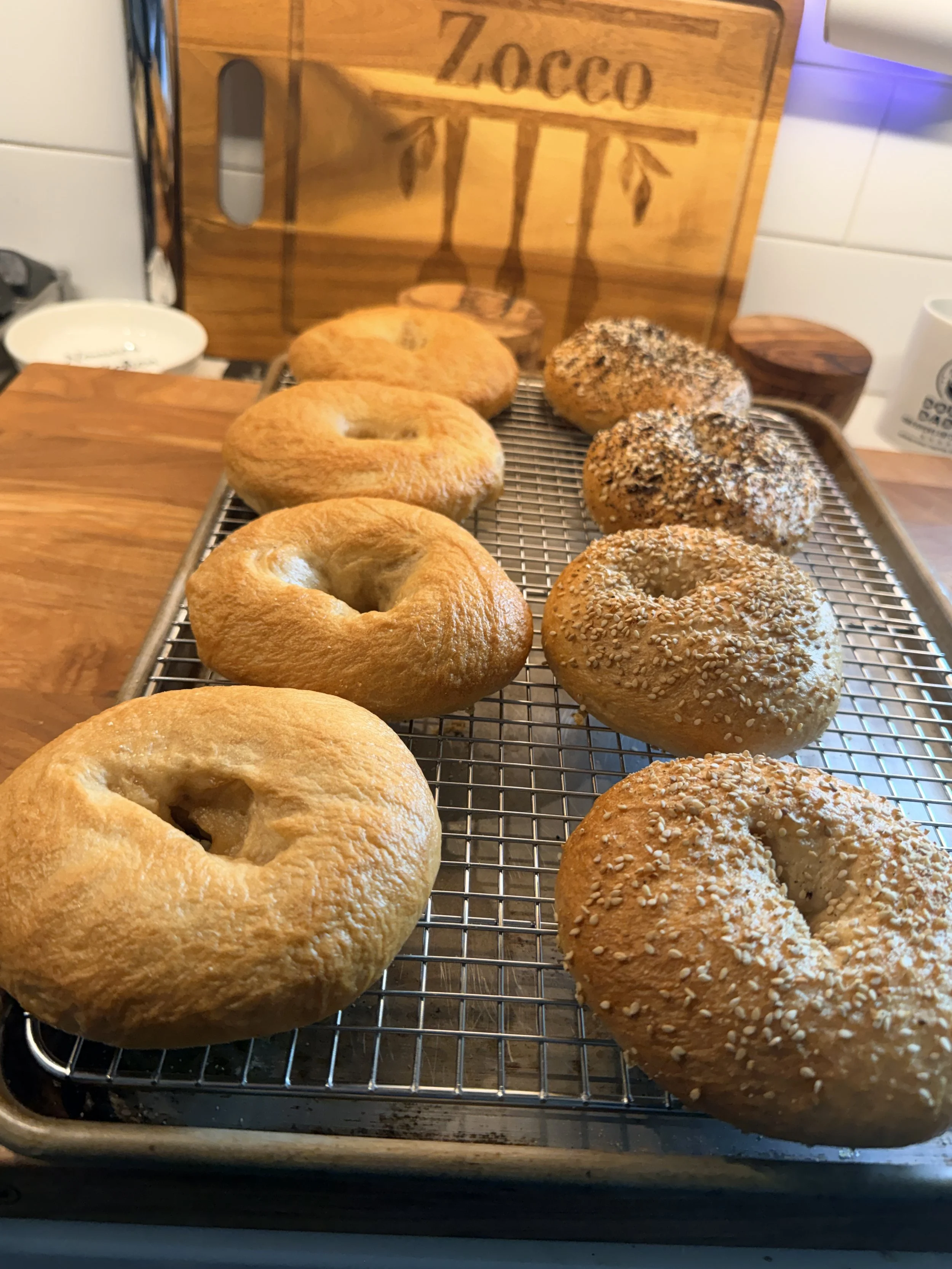
Bagels - Overnight Poolish
Yield: 8 large bagels
Portion size: 125 g each before boiling
Total dough: Approximately 1,034 g
Bake temperature: 425°F
These homemade bagels use an overnight poolish to develop more flavor without the commitment of maintaining a sourdough starter. A small amount of instant dry yeast in the final dough keeps the process predictable, while boiling the bagels with barley malt syrup helps create that classic chewy crust and deep bagel flavor.
Ingredients
Poolish — Make the Night Before
100 g bread flour
100 g warm water
Small pinch instant dry yeast (IDY)
Final Dough
200 g prepared poolish
500 g bread flour
300 g warm water
15 g sugar
7 g instant dry yeast (IDY)
12 g salt
For Boiling
Large pot of water
2 tablespoons barley malt syrup or honey
My preference: Barley malt syrup. It gives the bagels a more traditional flavor and helps develop that beautiful crust.
Optional Toppings
Sesame seeds
Poppy seeds
Everything bagel seasoning
Coarse salt
Your favorite bagel toppings
Instructions
1. Make the Poolish
The night before you plan to make your bagels, combine 100 g bread flour, 100 g warm water, and a small pinch of IDY.
Mix until all the flour is hydrated and you have a thick batter.
Cover and leave at room temperature overnight, approximately 10–14 hours.
By morning, the poolish should have expanded and be bubbly and aromatic.
You now have approximately 200 g of poolish ready for your bagel dough.
2. Mix the Dough
Add the 200 g poolish, 300 g warm water, 15 g sugar, and 7 g IDY to the bowl of a stand mixer.
Mix briefly to break up the poolish and distribute the yeast.
Add 500 g bread flour and 12 g salt.
Mix on low speed until the ingredients come together and form a stiff dough.
3. Knead
Using the dough hook, knead for approximately 8–10 minutes, until the dough becomes smooth, strong, and elastic.
Bagel dough should feel considerably firmer than pizza or traditional bread dough.
You can also knead by hand, but be prepared for a workout. Consider it your excuse for eating the second bagel.
4. Bulk Ferment
Place the dough in a lightly greased bowl and cover.
Allow to rise at room temperature for approximately 60–90 minutes, until noticeably expanded.
The dough does not need to completely double in size.
5. Divide
Turn the dough onto your work surface.
Divide into:
8 portions × 125 g each
The recipe makes slightly more than 1,000 g of dough, giving you some extra to account for dough left behind in the mixing bowl or on the dough hook.
6. Shape the Bagels
Shape each 125 g portion into a tight ball.
If the dough keeps springing back while you’re shaping it, let the balls rest for 5–10 minutes before continuing.
Push your thumb through the center of each ball to create a hole.
Gently stretch and rotate the dough until the center opening is approximately 1½–2 inches wide.
Don’t make the opening too small. The hole will shrink as the bagels proof, boil, and bake.
7. Final Proof
Place the shaped bagels on a parchment-lined sheet pan.
Cover and allow them to proof for approximately 30–45 minutes.
You’re looking for them to become slightly puffy, not dramatically larger.
Don’t overproof them. Overproofed bagels can deflate or wrinkle excessively when they hit the boiling water.
8. Preheat the Oven
Preheat the oven to:
425°F
Bring a large pot of water to a gentle boil.
Add 2 tablespoons barley malt syrup or honey and stir to dissolve.
9. Boil the Bagels
Working in batches so you don’t overcrowd the pot, carefully lower the bagels into the boiling water.
Boil for:
60 seconds on the first side.
Flip and boil:
60 seconds on the second side.
For an even thicker, chewier crust, you can increase the boiling time to approximately 90 seconds per side.
Remove with a spider or slotted spoon and allow the excess water to drain.
10. Add the Toppings
Immediately after boiling, while the surface is still wet, add your desired toppings.
Don’t be shy with them. Some will inevitably end up on the sheet pan instead of the bagel.
11. Bake
Place the bagels on a parchment-lined baking sheet.
Bake at 425°F for approximately 20–25 minutes, rotating the pan halfway through if your oven browns unevenly.
You’re looking for a deep golden-brown crust.
Don’t pull them just because they’re technically brown. A little extra color means more flavor.
12. Cool
Transfer the finished bagels to a wire cooling rack.
Let them cool before slicing.
Or stare at them for five minutes, decide you’ve demonstrated sufficient restraint, and cut one open anyway.
Dough Daddy’s Notes
Why use a poolish?
A poolish is a simple preferment made with equal weights of flour and water and a tiny amount of yeast. Allowing it to ferment overnight develops flavor and aroma before you ever mix the final dough.
Why bread flour?
The higher protein content helps develop the strong gluten structure and chewy texture that separates a real bagel from a round piece of bread with a hole in it.
Why boil bagels?
Boiling sets the exterior of the dough before baking. That’s what helps create the dense, chewy crumb and distinctive bagel crust.
Honey or barley malt syrup?
Both work, but I prefer barley malt syrup for a more traditional bagel flavor.
Dough Daddy Cooks
Bringing people together, one bite at a time.